Linux patch management

Linux patch management
for your entire fleet

OpsFabric scans your entire Linux fleet for missing patches, security, kernel, userland, and lets you apply them in controlled rollouts.
One dashboard. Every distro. No guesswork.

Ubuntu, Rocky, Debian, Alma, SUSE + more
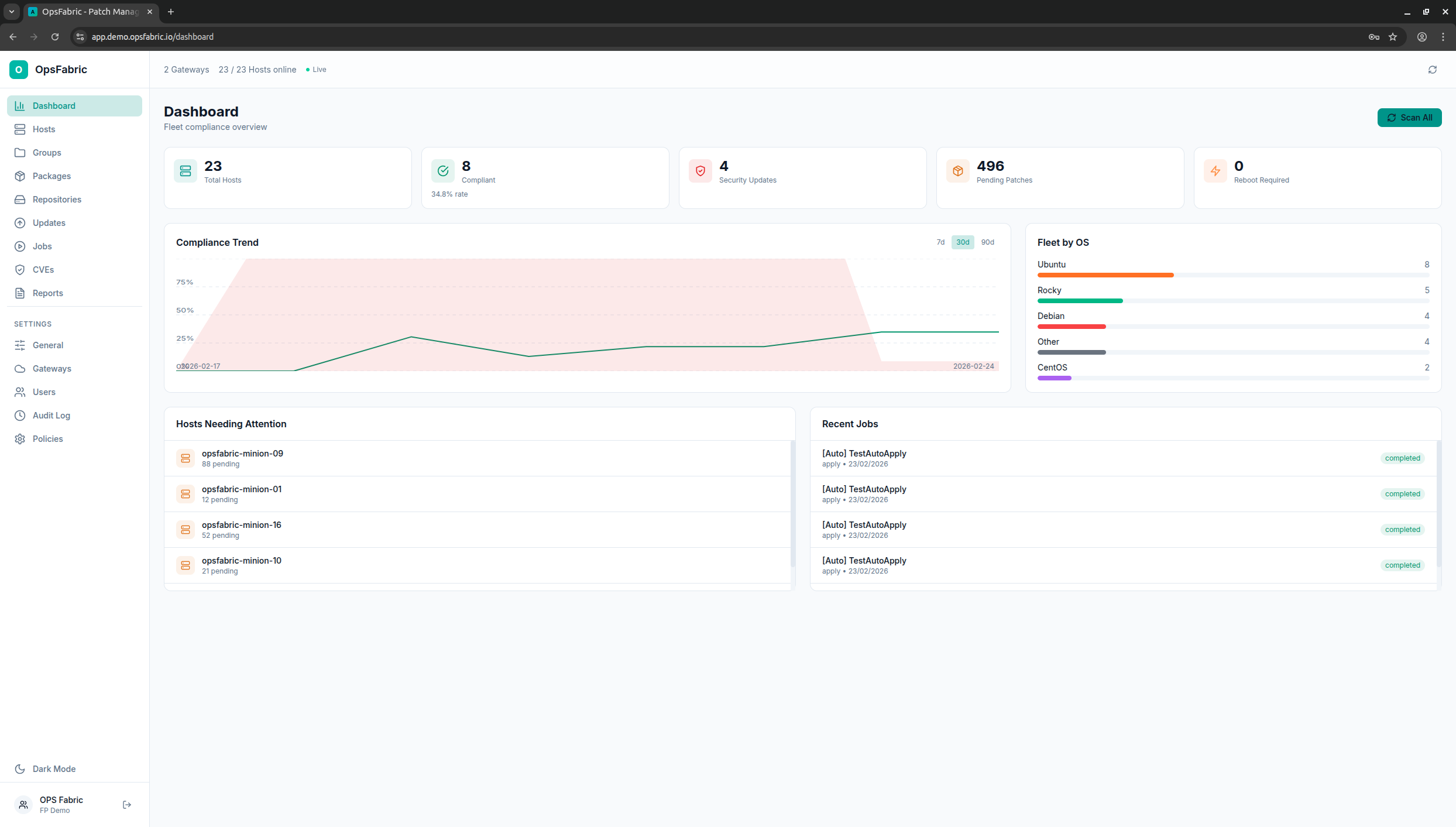
OpsFabric Dashboard
01

You're patching blind

SSH into boxes one by one. Run apt list --upgradable. Paste into a spreadsheet. Forget which server you already did. Repeat next month.

02

Mixed distros, mixed mess

Half your fleet is Ubuntu, a quarter is Rocky, and someone spun up a SUSE box three years ago. Every distro has different commands, different repos, different CVE feeds.

03

Compliance is a fire drill

Auditor asks for patch status across all production hosts. You spend two days generating reports that are outdated by the time you hand them over.

Patch management for Linux fleets

Fleet-wide scanning

Scan every host with one click. Full update detection or security-only. Per-host, per-group, or the entire fleet. Results stream in real-time as each host completes. Detects pending patches, security updates, kernel vs userland, and reboot requirements across apt, yum, dnf, and zypper automatically.

Preflight, dry-run, rollback

Run preflight checks (disk space, package locks, reboot status) before patching. Preview changes with dry-run. Roll back with apt --allow-downgrades or dnf history undo if something goes wrong.

CVE tracking

Every pending patch is mapped to its CVEs with CVSS severity (critical, high, medium, low). Browse affected hosts per CVE, see fix-available status, and filter by severity.

Scheduled jobs

Create one-time or recurring patch jobs with cron expressions. Scan, apply, dry-run, or rollback on a schedule. Target specific hosts, groups, or the whole fleet. Track job status and rerun failed jobs.

Compliance & reporting

Daily compliance snapshots with trend charts over 7, 30, or 90 days. Per-host compliance status (compliant, warning, critical). Export reports for auditors. Full audit log of every action with user, timestamp, and details.

Package pinning & repo proxy

Pin package versions to prevent unwanted updates. Pinned packages are excluded from apply operations automatically. Centralized repository definitions with on-premise caching proxy through the gateway.

Machine groups

Organize hosts with regex-based auto-assignment rules. Match on hostname, OS, version, or tags. Run scan, preflight, dry-run, and apply operations on entire groups at once.

Multi-tenant isolation

Each tenant gets isolated gateways, users, and host pools. Role-based access control with super admin, tenant admin, and user roles. No data leaks between tenants.

Real-time updates

Live WebSocket push for gateway status, host online/offline events, scan completion, and apply progress. Results stream as each host finishes. Persistent notifications across page navigation.

Built on an event bus, not polling

Most patch tools poll. OpsFabric pushes. Commands fan out to every host simultaneously and results stream back in real-time.

bulk scan -23 hosts across 2 gateways
15:25:23 Scan fired across 2 gateways (23 hosts, full scan)
15:25:26 srv-03 complete (1/23) -0 updates
15:25:27 srv-09 complete (2/23) -88 updates
15:25:27 srv-04 complete (3/23) -0 updates
15:25:27 srv-15 complete (4/23) -112 updates
15:25:28 srv-14 complete (6/23) -15 updates
15:25:29 srv-01 complete (10/23) -12 updates
15:25:30 srv-12 complete (15/23) -55 updates
15:25:31 srv-13 complete (19/23) -72 updates
15:25:34 srv-16 complete (23/23) -52 updates
15:25:34 All 23 hosts scanned (2 gateways, 0 timed out)
17:06:33 Package inventory across 2 gateways (23 hosts)
17:06:34 srv-03 546ms 392 packages
17:06:34 srv-02 556ms 569 packages
17:06:34 gateway-2 227ms 584 packages
17:06:35 srv-01 372ms 536 packages
17:06:35 srv-13 511ms 430 packages
17:06:35 10,758 packages inventoried across 23 hosts (avg 468ms/host)
15:26:30 liveness probe - 23 hosts responded in 198ms
23 hosts
across 2 gateways
<1 sec
per host scan
10,758
packages inventoried in ~2s
~200 ms
liveness probe, all hosts

Multi-gateway fan-out

One scan fires across all your gateways in parallel. Each gateway fans out to its hosts simultaneously via the event bus. Two gateways, ten gateways - they all fire at the same time.

Event-driven streaming

Results push through the event bus as each host completes. The UI updates instantly via WebSocket. No refresh buttons, no stale data, no wasted cycles.

Async bulk operations

Bulk scans and applies fire asynchronously. You get an instant acknowledgment, then progressive per-host results as they complete. No waiting for the slowest host to see anything.

Thin gateway relay

The gateway makes a single call per operation. All package logic runs directly on the managed host. The gateway has zero OS awareness - it just relays.

Automate the rules, not just the patches

Define when, what, and how patches get applied. OpsFabric enforces your policies server-side so nothing slips through.

Patch windows

Define maintenance windows per group with day-of-week and time slots. Jobs targeting a group outside its window are blocked with a 409 and told when the next window opens. No surprises during business hours.

web-servers: Sat 02:00 – 06:00 UTC

Auto-apply

Automatically patch when qualifying updates exist. Configure severity filter, delay period, and reboot policy per group. Security-only at high severity with 24h delay? Done. Fully hands-off or as controlled as you need.

security only · max severity: high · 24h delay · reboot: if required

Compliance targets

Set SLA targets per severity: critical patches within 48 hours, high within 7 days. OpsFabric tracks violations per host, generates daily compliance snapshots, and gives you trend data over 7, 30, or 90 days for auditors.

critical: 48h · high: 7d · medium: 30d · low: 90d

Three pieces, zero friction

1

Deploy the gateway

Download OpsFabric Gateway for your site. Unzip, run ./run.sh. The gateway connects to OpsFabric cloud over WebSocket. No inbound ports needed.

unzip opsfabric-gateway-acme.zip && cd opsfabric-gateway && ./run.sh
2

Add your hosts

Start the gateway and it generates a one-liner install script for your tenant. Run it on any Linux host to install the agent. Accept keys from the dashboard. Hosts appear in seconds.

curl -sL https://<gateway-endpoint>/install | sh
3

Scan and patch

Hit scan. See what's pending. Apply security patches to your whole fleet or pick specific packages on specific hosts. Track everything in the audit log.

Dashboard → Patches → Scan All → Apply Security Patches

Multi-tenant by design

Each tenant runs an isolated gateway on-premise. The cloud handles the UI, API, and coordination. No inbound ports required on your network.

OpsFabric Cloud
Dashboard, API, database, coordination
WebSocket (outbound only)
Tenant A
Gateway
Linux Hosts
Tenant B
Gateway
Linux Hosts
Tenant C
Gateway
Linux Hosts

Built for operators, not slidedecks

Everything you need on one screen: patch status, host compliance, job history. No 14-click workflows.

Best viewed on desktop. Tap any thumbnail to preview.

https://app.opsfabric.io/dashboard
OpsFabric Dashboard

Tech specs

Supported distros

  • Ubuntu 22.04, 24.04
  • Debian 12
  • Rocky Linux 9
  • RHEL 9
  • CentOS Stream 9
  • SUSE Linux Enterprise 15

Package managers

  • apt Debian / Ubuntu
  • dnf RHEL / Rocky / CentOS 9
  • yum RHEL / CentOS 7-8
  • zypper SUSE

Deployment

  • Cloud-hosted control plane
  • On-premise gateway per tenant
  • One-click gateway bundle download
  • WebSocket outbound only, no inbound ports
  • TLS everywhere

Security

  • JWT authentication with token refresh
  • Tenant-level data isolation
  • Role-based access (super admin, tenant admin, user)
  • Full audit logging with action filtering
  • Gateway secret rotation

API & integrations

  • RESTful API with OpenAPI/Swagger docs
  • WebSocket real-time event streaming
  • Bulk scan and apply with progress updates
  • Repository proxy with on-premise caching
  • Pydantic request/response validation

Stop SSHing into boxes to check patches.

OpsFabric is launching soon. We're onboarding teams managing 50+ Linux hosts who are tired of spreadsheets and cron jobs.

No credit card. No 45-minute demo call. We'll send you access credentials when we launch beta.

You're on the list! We'll be in touch.